


What We Can Do About The Connection Between Loneliness & Bullying
Have you ever felt like bullying and feeling lonely were connected in ways that feel hard to break? You’re right: Research shows they are part of the same repeating loop.
Loneliness and bullying are deeply linked in a cycle that can harm a young person’s social, emotional, and physical health (González‑Abaurrea et al., 2025). While bullying can cause youth to withdraw and feel excluded, loneliness itself can also make a young person more vulnerable to being bullied or even to becoming a bully themselves. The loop goes both ways!
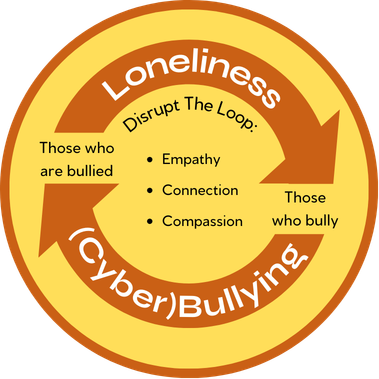
But there are things we all can do to stop this loop from playing on repeat.
WHAT WE KNOW ABOUT LONELINESS AND BULLYING:
Youth who are bullied often report higher levels of loneliness, social rejection, and lower self-worth than peers who are not. A systematic review of 100 studies shows this part of the loop is widespread, especially during adolescence: there are consistent, bidirectional associations (see image above) between loneliness and both traditional bullying and cyberbullying (González‑Abaurrea et al., 2025). Bidirectional means a relationship that goes both ways; bullying can lead to loneliness and vice versa!
Loneliness can both precede being bullied and increase when youth are bullied over time (González‑Abaurrea et al., 2025). Why? Bullying damages trust in others and reduces the chances of forming new friendships or support networks, making it even harder to escape the cycle of victimization and distress (Liu et al., 2025).
Those who bully are lonely, too. Despite common misconceptions, youth who engage in bullying behaviors also tend to experience loneliness, social insecurity and strained relationships with peers (González‑Abaurrea et al., 2025).
The digital world can speed up this loop. Cyberbullying can amplify feelings of isolation, especially because it can happen anytime and anywhere. It can be both more public and harder to notice, based on different ways cyberbullying happens online (González‑Abaurrea et al., 2025; Deschamps & McNutt, 2016). Youth often report feeling especially distressed by online exclusion or harassment because it can feel inescapable. The digital nature blurs the boundaries between school, home, and online life, and leaves them without a clear place to disconnect or feel safe.
Social connection and parent support really make a difference. Social connectedness and parental support act as protective factors, reducing the impact of bullying on loneliness and interrupting the cycle of isolation and distress (Liu et al., 2025).
As a developmental psychologist who has studied adolescent relationship violence and digital wellness, I want to emphasize that the loop-like relationship between loneliness and bullying has implications across adolescence and into adulthood, as well as for our increasingly digital world.
For younger teens (~10-13 years old), we know that subjective well-being and friendship satisfaction are among the strongest protective predictors against loneliness. However, things get more complicated later in adolescence (13+ years), as social exclusion and problematic internet use–or unhealthy digital habits–become more predictive of loneliness (Pourasadi et al., 2025). Of course, there are important gender differences to be aware of. Research suggests that girls’ experiences of loneliness become more closely tied to emotional distress and social exclusion, whereas boys’ feelings of loneliness are more strongly related to their overall sense of happiness and wellbeing (Pourasadi et al., 2025).
The bullying-loneliness loop does not just impact individuals when they are young. Bullying has been associated with higher loneliness not just during childhood and adolescence, but continues into adulthood (Lissitsa & Kagan, 2024).
A study by Kim and colleagues (2025) found that adolescents who experienced higher levels of loneliness were more likely to have worse mental health outcomes (e.g., depression, PTSD), poorer psychological well-being (e.g., lower optimism and life satisfaction), and some social outcomes (e.g., lower romantic relationship quality) up to 20 years later, further stressing the importance of reducing loneliness for youth.
For similar reasons, disrupting the bullying-loneliness loop in digital spaces becomes even more important as youth age. Research shows that as adolescents grow older, problematic internet use becomes increasingly associated with loneliness, underscoring how digital behaviors can intersect with social and emotional well-being (Pourasadi et al., 2025). It is important to understand that digital use alone does not cause bullying or cyberbullying, but does present another complex and ever-changing social space where youth may encounter the bullying-loneliness loop. This may also be because loneliness can increase one’s reliance on social media as a coping strategy and to compensate for feeling lonely, a pattern observed across the life course (Lissitsa & Kagan, 2024). If unaddressed, unhealthy digital use that is a response to unmet social needs is really just reinforcing loneliness and if unaddressed, could carry forward into later life and digital habits.
TLDR;
Although bullying and loneliness form a dangerous feedback loop for young people, they share some of the same solutions: social connection, empathy, and belonging!
A quick note… If you or someone you care about is being bullied, the most important thing is to talk to a trusted friend or adult. Bullying is not something we can or should manage alone! Bring others into your story so they can be the support you need.
CALL TO ACTION FOR YOUTH:
- Be the Interruption: Notice when a friend or peer is being left out online or in real life. Then, take one small step to include them: a message, an invite, or checking in can break the loop!
- Never Loop Alone: Bullying thrives on silence and isolation. If you’re being bullied, know that it is never your fault. Reach out to someone you trust, so you don’t have to carry it alone. This could be a friend, caregiver, teacher, or coach!
- Curate Compassion: Follow, mute, and engage in ways that help you feel connected. If scrolling or comparing yourself to others online leaves you feeling more alone, it’s okay to step back and reset. This tip works offline, too: practicing kindness in everyday moments really counts.
CALL TO ACTION FOR CAREGIVERS:
The following tips aim to disrupt the loneliness-bullying loop over time, but if you recognize or notice signs of bullying in your child’s school the most effective thing you can do is advocate for peer-led programs, like Club7, that help develop connection, social health, and empathy.
- Talk the Talk: Encourage open, ongoing conversations about peer relationships and feelings of loneliness. You can do this by asking open-ended questions about friendships, exclusion, and online experiences. Normalizing loneliness as something many young people (and adults!) experience helps prevent it from feeling like a personal failure.
- Look Beyond Likes: Loneliness doesn’t always look like being alone. Youth with a lot of likes or “friends” online can be lonely, too. Be sure to pay attention to changes in mood, sleep, or behavior, especially after social or online interactions. These can be signs of bullying or isolation.
- Be (Really) Present: Parental support matters. Your presence, belief, and availability can soften the impact of bullying and help youth rebuild trust and connection. Having a strong relationship can also prime the wheel for important conversations about mental health when support is needed.
- Teach Skills, Not Just Limits: Actively help youth learn how to recognize harmful online dynamics, disengage from toxic spaces, and use technology as a tool for connection rather than a replacement for it. Youth need your help to build critical social and digital skills, not just for you to set limits for their digital use or social life.
DOWNLOAD THE ARTICLE VIA PDF: HERE
This article was authored by Dr. Rachel Hanebutt, who currently serves as a member on Only7Seconds’ Scientific Advisory Board.

DR. RACHEL HANEBUTT
Dr. Rachel Hanebutt, Ed.M., M.A., M.S. is currently an Assistant Professor of Psychiatry and Holt Family Rising Professor at Georgetown University’s Thrive Center for Children, Families, & Communities and Department of Psychiatry at Georgetown University School of Medicine. Dr. Hanebutt completed her doctorate at Vanderbilt University, in the Community Research and Action program at Peabody College. Her dissertation focused on adolescent digital health strategies and teen wellbeing in partnership with #HalfTheStory, a leading educational intervention nonprofit in the space.
GET CONNECTED: Website or LinkedIn
References for more information:
Deschamps, R., & McNutt, K. (2016). Cyberbullying: What’s the problem?. Canadian Public Administration, 59(1), 45-71. https://doi.org/10.1111/capa.12159
González-Abaurrea, E., González-Cabrera, J., Ortega-Barón, J., Escortell, R., & Machimbarrena, J. M. (2025). Bidirectional relationships between peer victimization, loneliness and solitude in adolescence: A systematic review. Adolescent Research Review, 1-53. https://doi.org/10.1007/s40894-025-00266-2
Kim, E. S., Wilkinson, R., Holt-Lunstad, J., & VanderWeele, T. J. (2025). Loneliness during adolescence and subsequent health and well-being in adulthood: An outcome-wide longitudinal approach. The Journal of adolescent health : official publication of the Society for Adolescent Medicine, 77(1), 66–75. https://doi.org/10.1016/j.jadohealth.2024.12.011
Lissitsa, S., & Kagan, M. (2024). The enduring echoes of juvenile bullying: The role of self-esteem and loneliness in the relationship between bullying and social media addiction across generations X, Y, Z. Frontiers in Psychology, 15, 1446000. https://doi.org/10.3389/fpsyg.2024.1446000
Liu, H., Lan, Z., Wang, Q., Huang, X., & Zhou, J. (2025). A path to relief from the intertwined effects of school bullying and loneliness: the power of social connectedness and parental support. BMC public health, 25(1), 1850. https://doi.org/10.1186/s12889-025-23064-w
Pourasadi, Z., González-Carrasco, M., Cerrato, S. M., & Aznar, F. C. (2025). Longitudinal study of gender differences in adolescent sense of loneliness: The roles of subjective well-being, bullying, and problematic internet use. Child Indicators Research, 1-35. https://doi.org/10.1007/s12187-025-10316-9
View comments
+ Leave a comment