

What if “just breathe” is not just something we say to move past a difficult moment, but something we practice to move into connection?
What if, in the middle of stress, misunderstanding, or loneliness, we could return to ourselves just enough to return to each other?
What We Know:
Many of us, youth and adults alike, are navigating elevated stress and disconnection. Youth loneliness and mental health challenges continue to increase, reminding us that connection is essential for well-being.
As our stress persists over time, our nervous systems often remain in “threat detection mode” rather than returning to steadiness and regulation. This sustained stress response slowly begins to overwhelm our internal systems, keeping us in “threat detection mode” and out of psychological safety. When we leave “safety,” we lose our capacity for connection. It is during these times where we may have increased and ongoing bouts with disconnection and loneliness. We may become easily offended; we may misread tone, withdraw, react quickly, or assume the worst. This is not because we do not care… It is because our brains and bodies are trying to protect us. Loneliness and stress are not only emotional experiences but physiological ones, shaping how we think, feel, and respond. When we understand this, we can begin to replace judgment with awareness, and disconnection with intentional choices for connection.
This is where the 5Rs and specifically, breathing becomes more than a pause, it becomes a pathway. One of the most effective tools we can use is a physiological sigh: a quick double sniff deep inhale (the double sniff to fully expand the lungs), a brief hold, and a long exhale.
This process reduces carbon dioxide and lowers stress hormones like cortisol, adrenaline, and norepinephrine, restoring clarity to our center of reason, our prefrontal cortex, and helps us feel safe to connect. Structured breathwork reduces anxiety within a single session. [3] [9]
“Just Breathe” is an invitation: to breathe into connection. Together, we can practice simple ways to RECOGNIZE and become aware of what is happening within us and around us. Then to REGULATE to bring balance and clarity, and by using the REFRAME, RECLAIM, and RESPOND steps, we can move toward one another with compassion, co-regulating, rebuilding trust, and strengthening belonging, agency, and mattering, one moment at a time.
The 5Rs: Insights for all
We are not broken. We are often dysregulated or disconnected.
When we understand that, we gain the ability to shift our mindsets together.
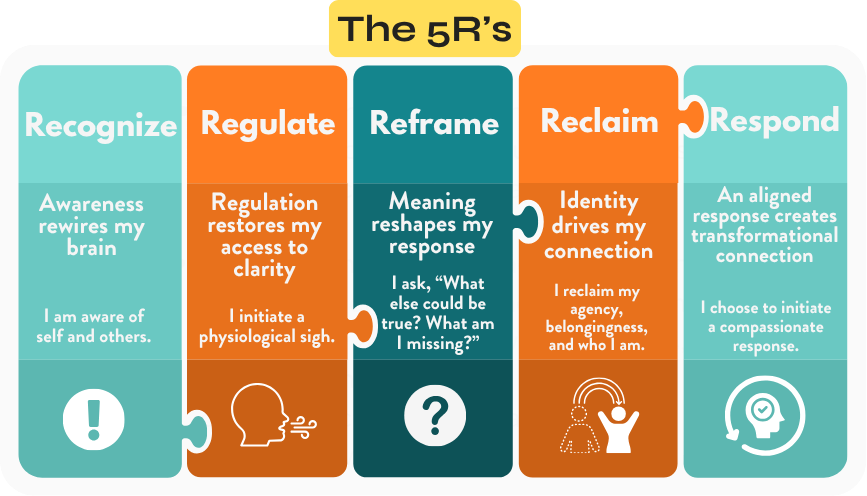
The five moves below apply to all of us. Using the 5Rs of the Adaptive Leader BrainTM, we can learn these steps, clockwise, from Right to Left to return us to safety and clarity as each R builds on the last. When we find ourselves in disconnection or stress, this 5R Pathway leads us directly from RECOGNIZE to REGULATION to REFRAME, RECLAIM and finally to a compassionate and regulated RESPONSE; ready to initiate or receive connection. *Following our physiological sigh (REGULATION), the entire pentagon sequence takes ONLY7SECONDS…
| The 5Rs | For Youth | For Caregivers |
| Pre-work | N/A | Our regulation will signal safety to others. We need to come into regulation through this process first, and then model the same alongside youth. |
| R1 RECOGNIZE Awareness alerts my brain..I am aware of self and others. | Our body detects stress before our mind catches up. We notice what is happening in our own body (tight chest, shallow breath, sweaty palms); We notice what is happening with others also (their body language, their breath, etc.).We “read ourselves” and we “read the room” and we know if we are activated in a stress response. | We notice our own state first in order to meet youth with a regulated presence. Awareness of ourselves (interoception) and others (neuroception) is “reading ourselves and the room” and helping our youth do the same. |
| R2 REGULATE Regulation restores my access to clarity;I initiate a physiological sigh. | We use the Physiological Sigh: the double sniff inhale, brief hold, and long exhale. This lowers stress hormones and opens our capacity for receiving and initiating connection and clarity of thinking. | We regulate ourselves before we redirect. When dysregulated, neither we nor our youth can access clarity or executive functions. When we practice and normalize the Physiological Sigh, our co-regulation is contagious. |
| R3 REFRAME Meaning reshapes my response”What else could be true? What might I be I missing?” | We ask: What story have I been telling myself (during my stress response)? What else could have been true? What am I missing? Interrupting automatic reactions and thoughts helps us to move from reacting to reflecting, and opens the door to understanding, empathy, and creating a compassionate response. | We REFRAME before we assume. We stay curious instead of certain or assuming. We validate before we problem-solve. Our brain learns better when it first feels understood. We meet our youth |
| R4 RECLAIM Identity drives my connectionI reclaim my agency, belongingness, and who I am | We are not defined by our hardest moments. Reconnecting with our agency (our own power/capacity), our identity, and our convictions of who we are and what we’re capable of increases our capacity to connect with others in empathy, authenticity, and compassion. | We anchor ourselves in who we are, in our agency, purpose, conviction, and in our role as regulated, caring, and present-moment aware adults. Our identity, purpose, and presence work together to help shape our youths’ environment. It is critical that we do this work first and beside our youth. We help them claim their agency and fully know that they matter. |
| R5 RESPOND My aligned response creates transformational connectionI choose to initiate a compassionate response | We choose intentional connection. A pause, a look, a compassionate word… small moments of connection shift everything. Connection doesn’t require perfection; it begins with our regulated, listening, attentive, and compassionate presence. | If we are regulated, we are fully capable of a countercultural response that can ignite transformation. An Extravagant Compassionate Action (ECA) is a compassionate response, even if it has an emotional or physical cost. This can have a transformational impact on youth. Our regulated tone, posture, pacing and message can carry significant impact. |
We don’t have to do this perfectly.
We just have to commit to practice and try.
TLDR;
In a time when many feel disconnected, overwhelmed, or unseen, the simplest tools (these 5Rs) can become the most powerful.
Recognizing that our threat response is activated, reminds us to initiate our breath. This can help anchor us in the present and guide us back to compassionate connection. When we learn to pause and recognize, breathe into our purpose and agency, and prepare to intentionally connect with compassionate action, we create the conditions and the brain pathways where connection can and will happen again, and again, and again.
Call to Action For Youth:
- This is our work; to be intentional with ourselves so that we can be intentional with each other. When stress rises, we don’t ignore it or react from it; we steady ourselves, and we choose to breathe to return to clarity so we can genuinely think, feel, reassess and respond with compassionate connection.
Call to Action For Caregivers:
- Caregivers, we go first; we practice this, we model it with youth and families, and we stay in it- even when it’s hard; so that youth don’t have to figure it out alone.
Together we create spaces and atmospheres where people feel seen, safe, and valued; and where connection becomes not just possible, but powerful enough to change and transform lives.
“When we model steadiness (regulation), we create space for others to return to themselves – and to connection.” Dr. Paige Wescott
This article was authored by Dr. Paige Wescott in collaboration with Only7Seconds. Dr. Paige Wescott currently serves as a member on the Only7Seconds’ Scientific Advisory Board.

DR. PAIGE WESCOTT
In joining Only7Seconds, Dr. Paige amplifies the mission to combat youth loneliness by bringing neuroscience-informed strategies that foster belongingness, resilience, and meaningful connection across youth, adults, families, and teams. Through thoughtful integration of brain science understandings with intentional practices, Paige equips youth, communities, and teams to connect not only in the moment- but to connect with deliberate and purposeful impact, embracing the potential for measurable and lasting positive change and increased growth.
Paige brings 36 years of teaching, coaching, and administrative experience across the P–20 spectrum, and holds a doctorate in Resilience and Educational Leadership. Currently Paige is continuing her educational neuroscience research begun with Dr. Lori Desautels at Butler University and serving with the non-profit NeuralEducation.org, as we empower educators, schools, and families worldwide with educational neuroscience-aligned practices to strengthen and further foster connection, learning, and the empowerment of growth culture in our schools, districts, homes, and community spaces.
GET CONNECTED: LinkedIn
REFERENCES:
[10] Yeager, D.S. (2024). 10-25: The science of motivating young people. Simon & Schuster.
View comments
+ Leave a comment