


What if the way we measure social connection is one of the obstacles preventing youth from feeling more connected?
What we know about social connection and how it is measured:
Social Connection is the opposite of loneliness: a felt sense of being seen, being valued, and belonging. Current assessments of youth social connection reveal that loneliness, or social disconnection, is widespread.
In a 2023 survey completed by 612 middle- and high-school students, nearly 20% of youth said they felt lonely “every waking minute” in the previous week (Only7Seconds, 2023).
As social connection and loneliness are both feelings that depend solely on an individual’s perception, scientists rely on self-report tools. The most widely used is the UCLA Loneliness Scale, which assesses subjective feelings of loneliness by asking individuals, for example, how often they feel left out, isolated, or as though they are lacking companionship (Daniel Russell, 1996).
As an alternative to traditional self-report tools, smartphone data has been successfully used to predict students’ social connection. Looking at screen-unlock frequency and duration, late-night phone activity, or location mobility, researchers were able to predict students’ UCLA Loneliness Scores with a 10–12% error margin. Those results reveal that reduced mobility, frequent screen checks, and irregular daily routines are the most reliable non-subjective indicators of social disconnection. (Wu, Jia, Zhang, & D’Alfonso, 2025).
Scientific Connection scales are useful for understanding social connection on a large scale, but simply administering a survey generally does not meaningfully improve how connected individuals feel. (Seewer, 2024).
Because these tools were not designed to guide everyday decisions or suggest next steps, youth are often left with information but no way to act on it, creating a need for tools that translate self-awareness into concrete action.
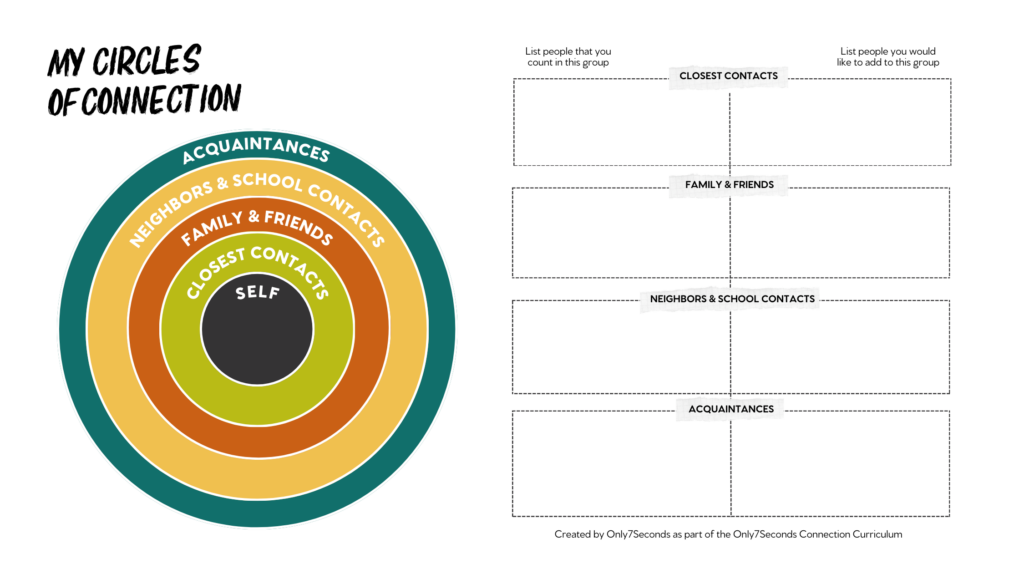
For youth themselves, an empowering way to evaluate their social connection and make changes may be a practical method that shifts the focus from “How disconnected am I?” to “What small action could strengthen my relationships this week?”. In order to do this, youth need to have a clear sense of their social network, and be able to evaluate their social connections. Several methodologies exist, including the “Circles of Connection” mapping approach (see below) which is one way of noting in your social network, a practice described in chapter 2 of the book, The Art & Science of Connection from Kasley Killam.
This simple tool helps individuals:
- list the social connections or sources with a positive social health impact
- reflect on the strength of each connection
- determine the level of satisfaction they feel about each connection
This reflection naturally leads the reader to pick one of the four proposed strategies to expand or deepen their social connections (Killam, 2024).
TLDR;
Validated scales help organizations create environments where youth feel safe and supported, but young people also need simple tools they can use themselves to guide and strategize their social capital.
When youth map and track their relationships and take small actions to strengthen them, social connection becomes something they can see, shape, and grow over time.
CALL TO ACTION FOR YOUTH:
- Loneliness or social connection scales used by schools or counselors provide an indicator of how supported we feel right now. They are not a label that defines us. After taking these assessments, talk with a trusted adult to interpret the results, explain the nuances, and translate them into actionable insights.
- Books such as The Art & Science of Connection propose actionable methods to map out social connections while providing a clear strategy to grow our sense of connectedness and belonging.
- Once we choose to start mapping the quality and quantity of our relationships, the most significant improvements will come from weekly actions to grow them. We can send a message, say hi, ask a question, or invite someone to do something with us. Then see how those steps improve our satisfaction with each social connection.
CALL TO ACTION FOR CAREGIVERS:
- Support young people when they engage with scientific connection scales. Help them understand that results are snapshots, not judgments, and, when needed, involve a behavioral health professional who can interpret the findings and guide next steps with care and nuance.
- Rather than giving direct advice, model the social well-being youth would benefit from. Map your social connections and identify strategies useful to strengthen your sense of belonging.
- Be open about your efforts, sharing what worked and what didn’t. Normalizing conversations about social connection helps young people see it as a shared human experience, not a personal flaw.
This article was authored by Maxime Fernandez Reiff in collaboration with Only7Seconds. Maxime Fernandez Reiff currently serves as a member on the Only7Seconds’ Scientific Advisory Board.

MAXIME FERNANDEZ REIFF
As a Tech Product Manager specializing in early-stage startups, Maxime Hernandez Reiff leverages his seven years of experience to deliver innovative and user‑centric solutions to complex business challenges. His expertise sits at the intersection of cutting‑edge SaaS solutions and startup dynamism, supported by an MBA and CSPO certification that strengthen his strategic approach. Maxime has successfully led four full product development cycles from ideation to launch, including a B2B SaaS platform that grew to more than 30,000 users.
GET CONNECTED: LinkedIn
REFERENCES:
Killam, K. (2024). The Art & Science of Connection.
Only7Seconds (2023). Youth Loneliness Survey.
View comments
+ Leave a comment