


In my teaching, research, and design work at Stanford, I’ve had the joy and privilege of working in a variety of ways with my friend and mentor, Dr. BJ Fogg, New York Times bestselling author of Tiny Habits®. In spring of 2024, teaching outside under a pair of large oaks to 24 mostly graduate students, we took on the topic of personal relationships in our course Behavior Design: Tiny Habits for Social Health and Happiness.
Here are three lessons from our course to help you on your journey with relationships, especially friendships.
3 Lessons from Tiny Habits for Social Health
Lesson 1: Intentionality is key to robust social health.
Background:
Let’s be honest, making and keeping good friends isn’t always easy in today’s world. People can feel isolated for many reasons, including technologies and worrying about work, school, or their future. For more on the structural factors that predict loneliness and isolation, see here and here. To help people feel more connected, we need support at many levels; schools, workplaces, and the communities we live in (see here for more).
In short, if you’re struggling, it isn’t your fault for lack of trying.
But you still have choices within your reach! Change might be more accessible than we think. In our 10 week course, nearly every student showed improvement in their social connection (as measured by several validated scales). So how did the course help our students intentionally improve their relationships?
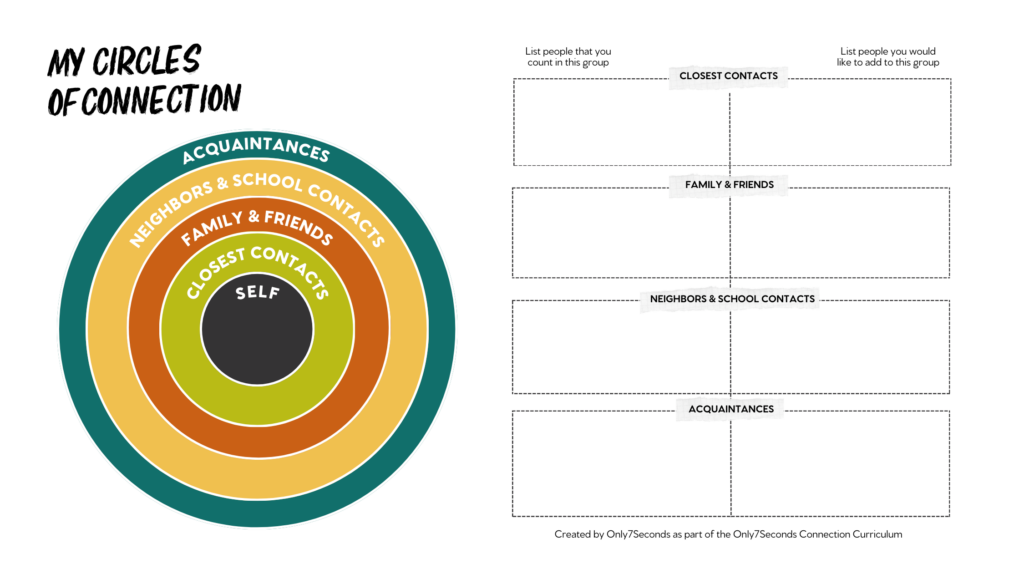
In our course we used a 3 concentric-ring model we called a “Buddy Map”, (Killam, 2024). You’re in the middle, and you can populate the three rings with people’s names. The inner circle is the smallest, but holds your closest relationships. These are people you confide in and are comfortable asking for nearly any kind of help or support you might need. The second circle contains your friends and close family members—people who you enjoy seeing, share history with, and can turn to for many, but not all, kinds of support. The third circle is the biggest and contains your acquaintances—people you’re familiar with, but you don’t share a particularly deep or regular relationship. Beyond that third ring we leave space to represent people you aren’t yet acquainted with. You might populate this area with names of people you might want to move into the third ring.
You might take some time to sketch out a Buddy Map (at Only7Seconds, we use the Circles of Connection linked below!) of your own, and once you see it laid out, figure out your aspiration for your social world. How would you want this map to look in 6 months? You may want to:
- Improve the quality or frequency of touch points in your relationships
- Become acquainted with somebody new
- Move somebody or several people from an acquaintance to a friend
- Or move someone from a friend to your inner circle
Lesson 2: Pick effective strategies and be creative
With that aspiration in hand, you can now brainstorm a wide range of behaviors that you can get yourself to do and which would be effective at that aspiration.
I’d suggest doing this yourself first by setting a 3-minute timer and writing down every idea that comes into your head. Think about one-time behaviors that would work, behaviors you might try for a week, and habits that you hope to adopt long-term. Collectively we call these Relationship-Building Actions or RBAs.
After doing your own brainstorming you may want to consult the list that our students came up with for more ideas: https://scrane.link/RBAs
Pick 2-3 RBAs to put into practice next week. Try to make them specific behaviors—set a when and where plan for each behavior.
Lesson 3: Start small and celebrate your efforts
Now here’s where the secret of the Tiny Habits® approach comes in: take your behavior and scale it way back.
Is there a tiny version of the behavior you can set as your standard?
Example: instead of smiling and greeting everybody you sit down next to in a day, maybe aim to do that at least once.
Is there a starter step you can do instead of the full behavior?
Example: if your goal is to text a friendly note to somebody every day, maybe start with just opening your texting app and picking somebody who you might send it to.
That way, even when your motivation is low, you’ve made the behavior so easy to do that you can almost always get yourself to do it. And whenever you’re feeling motivated enough, by all means go through with the full version of the behavior, perhaps several times! (In my own life, I find myself struggling to do my physical therapy exercises to rehabilitate my ankle. I decided my tiny habit would simply be to put the elastic band around my feet when I lie down in bed at night and be happy I did it! I can proudly say that this has led me to do 10x the exercises than I was doing before I took this tiny approach, without ever pressuring myself or feeling bad that I didn’t do the full set of exercises).
And importantly, when you do your tiny behavior, celebrate it! Even if it doesn’t feel like much worth celebrating, the fact that you’ve come this far with intentionality and completed a specific RBA to improve your relationships is probably way more than you were able to do before. Celebrate your efforts, your tiny behaviors, and of course the actual moments of connection when they happen.
For way more support on celebration and how it helps wire in your positive habits, see here.
After a more flexible summer schedule, many teens struggle to adjust to earlier wake-up times when the school year begins in the fall. This shift can make it harder for teens to get sufficient sleep, especially when early school start times are combined with homework, extracurricular activities, and other evening responsibilities that keep them up later. Even small changes to school schedules can make a big difference. Studies have shown that delaying school start times by as little as 30 minutes can help teens get more sleep and improve their overall well-being (Wheaton et al., 2016).
TLDR;
The world we live in today is not always designed to help people connect, build friendships, and maintain friendships. So if you’re struggling socially, it is not your fault! But you also don’t have to wait for things to improve before taking action.
By 1) getting clear on the kind of friendships you want and the social network you want, 2) choosing the Relationship-Building Actions (RBAs) and size of actions that might help, and 3) giving yourself credit for and celebrating your efforts along the way, you will be on the path to better friendships!
CALL TO ACTION FOR YOUTH:
- Decide which kinds of friendship you want. Do you hope to have a few friends or do you envision a larger social network? Research doesn’t prescribe a specific model or number of friends—a small circle of close friendships can support well-being as well as a larger one. Depth is what matters. .
- Choose Relationship-Building Actions (RBAs) you genuinely enjoy, and will practice. Scan for shared interests or activities, and if you don’t find any, exercise genuine curiosity about someone’s preferences. Showing others they matter by asking for their help or remembering something they said is also a powerful way to connect.
- Take a victory lap for every action you take. Remember that what really matters is consistency, not results. Actions taken to build a relationship are a weekly habit to cultivate, not a test of how likable you are. To help make it a habit, try habit stacking, and congratulate yourself every time you do something to build your relationships.
CALL TO ACTION FOR CAREGIVERS:
- Model the behavior you hope to see. Sketch your own Buddy Map, pick somebody in that outer circle you’d like to know better, and take the initiative to invite them to hang out, like at coffee. Then share what happened, especially when it doesn’t go as you expected. If somebody doesn’t reciprocate, say so out loud, share when it feels disappointing, and show that it didn’t stop you from reaching out to somebody else the following week.
- Help youth make their actions as simple and easy as possible. When a young person avoids a social step, no need to double down on encouragement. Instead, resize that step to make it attainable. If inviting an acquaintance to watch a movie seems too much, suggest they start by talking with that person about the movies they both want to see.
- Celebrate each first step they take and stop there. Show genuine appreciation for youth efforts while resisting the urge to ask what’s coming next or to offer advice. Resist transforming a weekly family gathering into a review of the moves taken. Let the young person decide what to share with you. Their intention matters more than anything else. If, despite the difficulties, they show up every week with the same intention to enrich their social life, they have surely earned praise. Take a moment to be proud of them, and another to be proud of yourself.
If you want to go deeper with this approach, Dr. Fogg and I recorded a 1-hr webinar using the same “buddy map” (Circles of Connection) approach we used in our Stanford course, which is free to view here .
Good luck on your journey. Use this approach wherever you feel moved to strengthen your connections with others. I’m rooting for you!
This article was co-authored by Steven Michael Crane, Only7Seconds Scientific Advisory Board member, Adjunct Lecturer at Stanford University; Principal and Founder of Synaptic Insights Consulting, and Max Fernandez-Reiff, who currently serves as a member on the Only7Seconds’ Scientific Advisory Board.

STEVEN MICHAEL CRANE
I research, design, and teach across a variety of fields, working in academia and industry. My life’s work is to study, share, and practice the principles of living that lead to greater wisdom, peace, and prosocial engagement in the world.
Born in Arizona in 1988, I received a BA in Human Biology (with a concentration in the Psychology and Philosophy of Successful Aging) from Stanford University in 2012 and an MS in Community Health and Prevention Research from Stanford Medicine in 2019. As a speaker, teacher, and writer, I cover topics ranging from biology and psychology to behavior design, and human nature. As a consultant and interdisciplinary researcher, I study human behavior (especially screen time), social connection, public health, and human flourishing. As Head of the Social Engagement Pillar of Stanford Lifestyle Medicine, I work to advance social connection as a fundamental tenant of healthy living and healthy aging.
My “extracurricular” priorities revolve around personal health behaviors, meditation, time in nature, and authentic social connection, particularly with my partner and much-adored children. I live cooperatively with family and friends in the hills of Los Gatos, California.
Email me at synapticinsights@gmail.com, follow me on LinkedIn or X, or sign up for my email list.
GET CONNECTED: Website
REFERENCES:
Killam, K. (2024). The Art & Science of Connection.
Fogg, B.J. (2025). Tiny Habits: The Small Changes that Change Everything.
View comments
+ Leave a comment